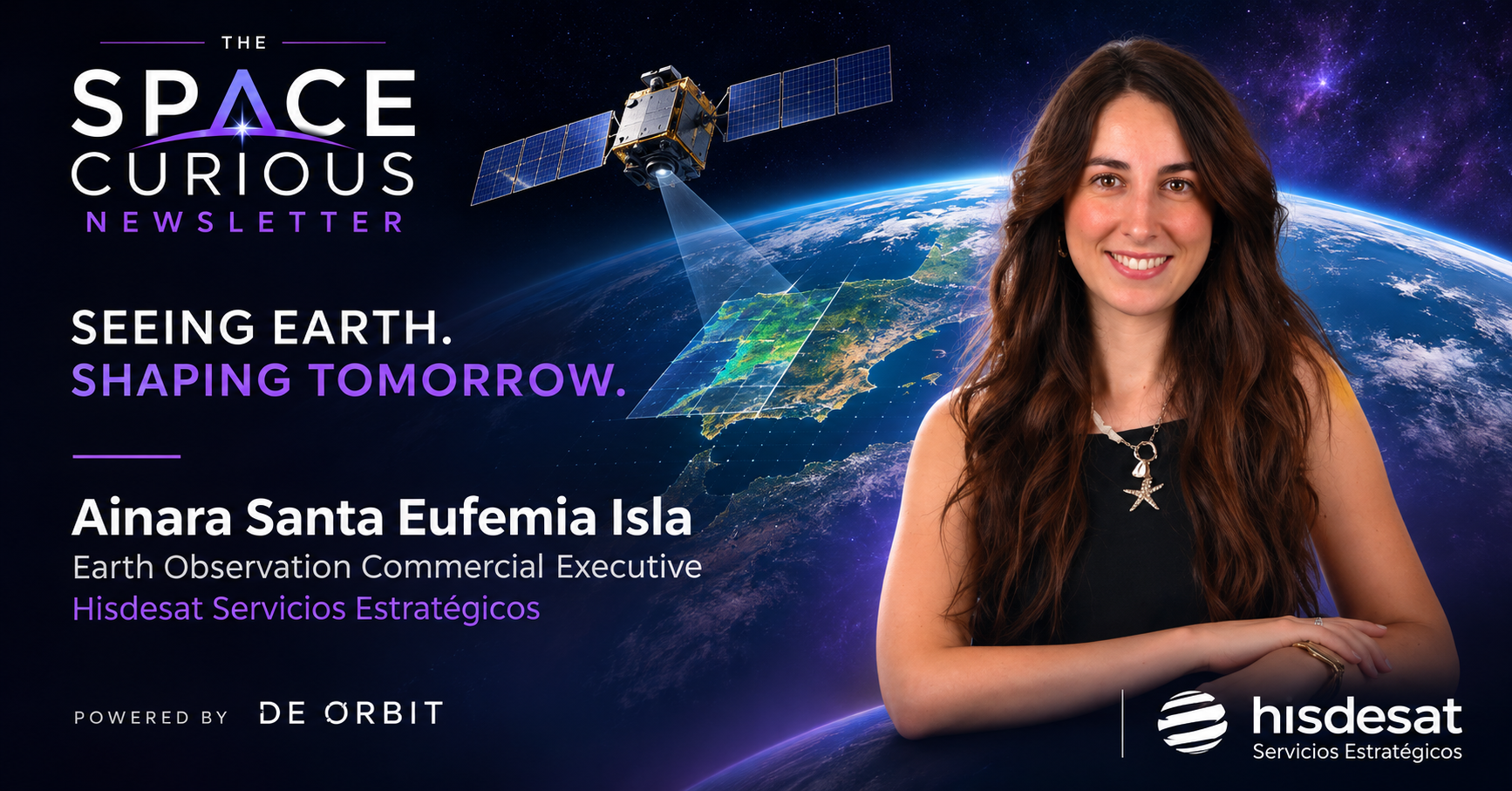
Ask most people who works in space and they'll describe an aerospace engineer with a calculator. Ainara Santa Eufemia Isla is proof that picture is wrong. She studied geography, fell into the space sector by chance, and has spent more than a decade in satellite companies across project management, Earth observation and international business development. She now works at Spanish satellite operator Hisdesat and mentors girls into STEM careers.
I'm Arn Terry, host of The Space Curious Podcast and founder of Daniel Ernest / DE Orbit, the space recruitment specialists. Ainara was the very first guest on the show. We talked about how she got into space, why the industry needs people from every background, and what she tells young girls who are deciding what to study. Here's what I took from the conversation. Her quotes are lightly edited for readability.
How did Ainara get into the space industry?
Not through a childhood telescope. "It wasn't planned," she told me. "I studied geography at university, so maybe it's not something really focused on the space sector."
Her first role was at Deimos, a company that owned satellites. She started in project management, coordinating internal teams from operations, learning how a mission runs and meeting customers. "And I started to love the space sector."
Two more space companies followed. She worked with satellite imagery, learned how missions are built and coordinated across teams, and moved into business development, opening new opportunities in international markets.
Can you work in space with a non-technical degree?
Yes, and Ainara's career shows how. Geography gave her a way in through Earth observation, the part of the industry that turns satellite images into decisions on the ground.
From there, the skills that moved her forward were coordination, communication and commercial judgement. None of those require an aerospace engineering degree. That's a message I'd give to anyone listening: if you studied geography, the "geo" in it can take you into geospatial work, Earth observation and much more.
How is Ainara inspiring girls into STEM?
Ainara volunteers as a mentor with the ASTI Foundation's STEM Talent Girl programme in Spain. It brings together women working in science, technology, engineering and maths, who give their free time to inspire the next generation.
One strand pairs a mentor with a young girl for a full year. "You try to accompany her, listen to what she needs, and support all the decisions she has to make in the next years," Ainara said. That covers what to study, where, which sector, and what jobs could follow.
The programme also goes into schools. "The idea is to start as early as possible, because there's a lack of role models specifically for girls in STEM careers." Mentors explain what they do day to day, then encourage the children "to think bigger and delete all the limits they probably have in mind".
The effect is visible. "It's amazing to see that the girls change their mind, and they start thinking about the possibility of a STEM career."
Why aren't more girls choosing STEM careers?
Ainara sees three pillars to the problem:
She was clear this isn't only about girls. "We have a lot of talent, and we need to push them to create, to imagine, to be curious." Teams built from different backgrounds ask different questions, and that's how better missions get designed.
What's the most inspiring thing about working in space?
For Ainara, it isn't the rockets. It's the teamwork. "To create a satellite or a mission, from the design on paper until you launch to space, a lot of people from all fields participate," she said. "You need to communicate very well, you need to collaborate, and you can deliver really big projects."
At DE Orbit, the space division of Daniel Ernest, we hear the same from hiring managers. Technical depth gets someone shortlisted. The ability to work across disciplines, explain their work and pull a team in one direction is what makes them an impact player on a mission.
How does Earth observation help people on the ground?
Ainara works with satellites that capture images of the Earth. "They give us a big picture of our world, so we can monitor what is happening there." Her examples:
"You can imagine the number of projects and use cases you can develop with the space sector," she said. "It's just amazing."
What will the space industry look like in 10 to 15 years?
Ainara won't put a ceiling on it. "I'm going to use the same sentence I use with the girls: there are no limits." She expects missions to Mars and a return to the Moon, more collaboration between countries, and a stronger focus on making the space sector more sustainable.
What's the biggest myth about working in space?
"Most people think that everyone working in the space sector is really brilliant at maths and reading continuously," Ainara said. "There are a lot of ways to be involved, not just as an engineer. You can be part of the communications team, marketing, human resources, the legal department. It's not just a matter of being an aerospace engineer."
Space Curious quick-fire round
Her closing message was about permission. Making space visible to young people gives them "permission to dream about it", takes away some of the pressure about the future, and lets them dream about big projects.
Are you hiring?
If you're building a space team and need engineers, operators or leaders who have done it before, I'd like to hear about it. Email me at arn.terry@danielernest.com or connect with me on LinkedIn.
About The Space Curious Podcast
The Space Curious Podcast is hosted by Arn Terry and powered by DE Orbit, the space recruitment division of Daniel Ernest. Each episode talks to the founders, engineers and leaders building the space economy. Watch the full conversation with Ainara Santa Eufemia Isla on The Space Curious Podcast.
Daniel Ernest / DE Orbit helps space companies build mission-critical teams, from Earth observation and satellite operations to business development, programme management and spacecraft engineering. To find out more, visit Daniel Ernest / DE Orbit.