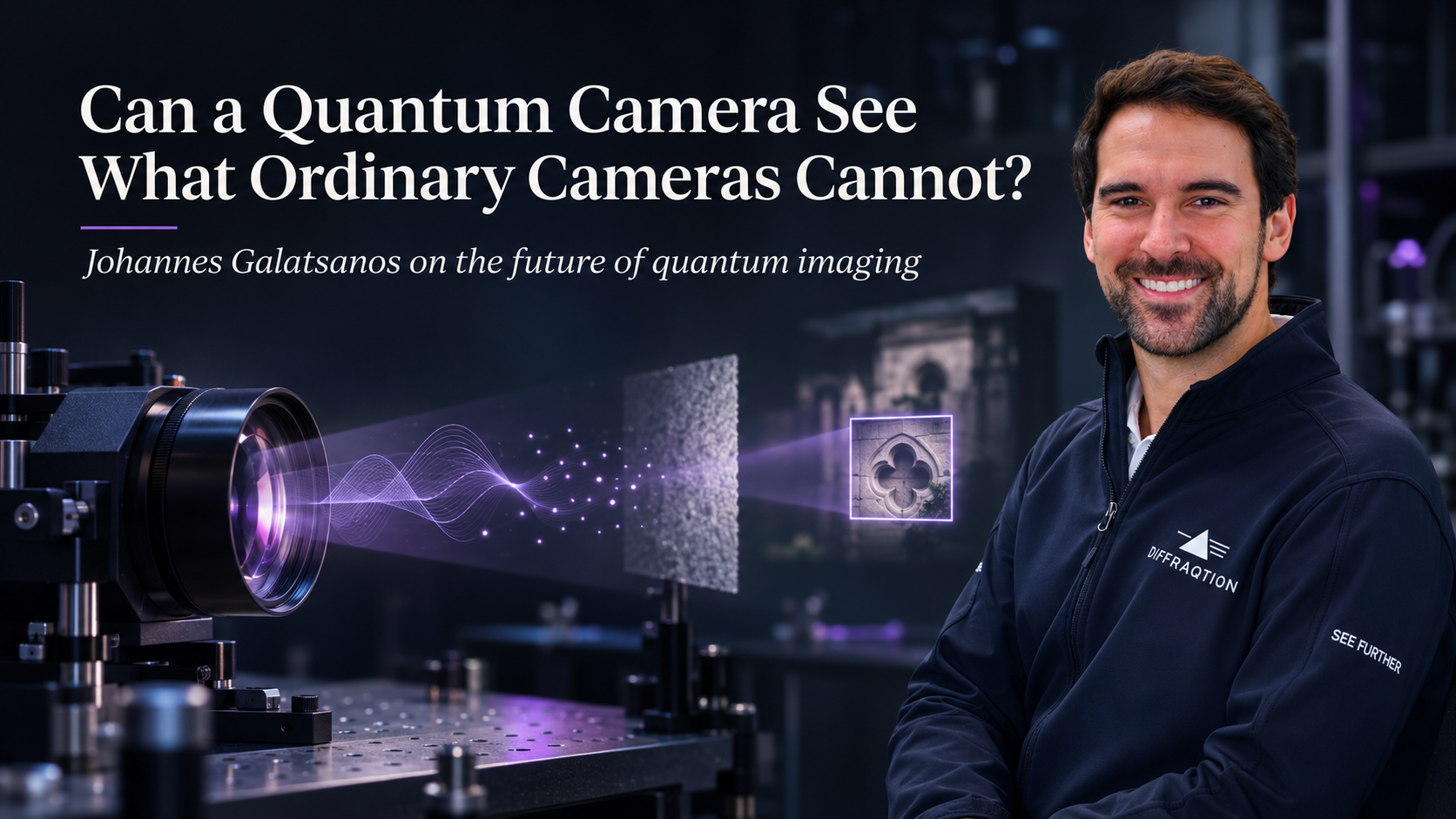
Every camera ever built hits the same wall: past a certain point, two things close together blur into one, however good the lens or the software. Johannes Galatsanos, co-founder and CEO of Diffraqtion, is building a quantum camera that sees past that wall. He's starting in space.
On The Space Curious Podcast, Johannes Galatsanos explained how the camera works and why space is its first market. He also shared why his engineering job adverts say "no PhD". Here's what I took from the conversation. His quotes are lightly edited for readability.
What is the diffraction limit?
The diffraction limit is the point where an optical system can no longer tell two nearby light sources apart. Johannes uses the eye test at the optician to explain it: "At some point it gets blurry. You can still see there is a letter. It's just, is this an E or a T? I really cannot tell."
Glasses can correct your eyes up to 20/20 vision, but no further. To see more detail you need a bigger lens, which is why astronomers build huge telescopes. Every camera, from a phone to a spy satellite, runs into the same limit.
How does a quantum camera see past it?
A conventional sensor turns light into electrical signals and keeps only how bright each pixel is. Johannes says that conversion throws most of the information away. His co-founder, Professor Saikat Guha, calculated that a standard camera captures only about 5% of the information a photon carries.
Diffraqtion's answer is to process the information while it is still light. "What if we didn't convert the light from photon to electron, but just kept it as a photon?" The camera looks for shapes in the light, known as modes, and runs vision AI optically before anything is converted. Diffraqtion says this gives up to 20 times higher resolution and up to 1,000 times faster processing.
Johannes sums it up in two promises: "I can see further and I can think faster."
Why does this matter so much in space?
The cost of a space telescope is mostly the size of its lens. Johannes puts large Earth observation and surveillance satellites at hundreds of millions of dollars, and Hubble-class telescopes in the billions. "You can get very expensive very quickly just by virtue of having a bigger lens."
The same is true on the ground. A commercial telescope can cost tens of thousands of dollars. An observatory costs tens of millions to build, plus millions a year to run. Diffraqtion's pitch is simple: "What if you could just upgrade it by using a different camera?" A small telescope with a quantum camera could do the work of a much larger one, at a fraction of the cost.
From a chess board to a quantum startup
Johannes was eight and playing chess on a small Greek island in 1997 when IBM's Deep Blue beat Garry Kasparov. His chess teacher told him he'd just been replaced and should start learning about AI. He took the advice.
He built AI systems for drones and the automotive industry. Then he built a data and AI team from scratch at a pharmaceutical company, eventually leading around 200 people. When quantum technology caught his eye, he went to Oxford and then MIT to find a technology worth spinning out.
At MIT he met Saikat Guha, a University of Maryland professor and director of the Center for Quantum Networks. The introduction came with a pitch: "You have to meet this dude. He's looking for aliens." Guha's quantum camera had been funded by DARPA and NASA research for over a decade, partly to hunt for exoplanets.
The moment that convinced Johannes came from one of Guha's papers. Guha was running a neural network on light, but only to calibrate where his telescope was pointing. "Wait a minute, that's not the calibration thing. That's the entire product."
How do you find a deep tech co-founder?
When Diffraqtion won DARPA backing and needed a CTO, Johannes wrote down the 10 skills the role needed and searched LinkedIn for them. Christine Wang came up first. She was a Harvard PhD with about 20 years building optical systems, and already a director of photonics at another company.
A mutual contact warned him she was happy where she was. "There's no way you're going to get her." He asked for the introduction anyway, and Christine heard the pitch. "I've been doing optics my entire life. I did not know you could beat the diffraction limit. I'm in."
This is the method I teach anyone hiring for a hard seat. Define the skills precisely, search for the people who have them, and use a mutual connection to get an introduction. The best people are rarely looking, so you go to them.
Why start in space and not smartphones?
A camera could go almost anywhere, so Diffraqtion looked at around 10 markets, including medical imaging, drones, cars and phones. Phones were ruled out first. Sony makes billions of image sensors a year and sells them for pennies, so a brand-new technology can't compete there yet. Cars were out too, because safety qualification can take five to ten years.
Space was different, because the lens is most of the cost of a satellite or telescope. "If you can shrink that, you shrink the entire thing." A saving that big makes customers willing to change how they work to get it.
Timing helped too. More than a million new satellites have been announced, and over a million pieces of debris between 1 and 10 centimetres are already in orbit. Orbit is "becoming very congested and very contested". That made space domain awareness (tracking what is happening in orbit) Diffraqtion's first market. Buyers include:
Where deep tech companies die
According to Johannes, most deep tech companies die in the jump from the lab to a product. "We spend so much time publishing just to show it's real, but we never built the thing."
Diffraqtion splits the work in two. Saikat Guha stays at the University of Maryland, where his lab keeps publishing science. The company doesn't publish and works with an engineering mindset. Its first-generation camera has moved into development and towards production. The second generation, with more advanced AI, is still in research.
The leadership mixes both mindsets on purpose. A photonics engineer runs engineering, an aerospace engineer runs operations, and a satellite systems builder sits alongside the scientists. Johannes calls himself a generalist with an AI background. Many quantum companies have too many scientists and too few engineers who know how to ship.
Do you need a PhD to work in quantum or space?
No, and Johannes says it can count against you. Some of Diffraqtion's engineering job adverts explicitly say "no PhD". They ask for an undergraduate degree plus hands-on experience, or at most a master's in engineering. "You probably have an advantage not having a PhD in this field."
The people he hires bring skills from next door to quantum, not from inside it:
His advice to anyone moving in from another field: learn the basics of quantum, then find a specialism the PhDs need. "Don't try to outcompete the PhDs in their PhD. Find something that they need."
I see the same thing from the hiring side at DE Orbit. Space and quantum companies rarely need more theory. They need people who have already built, tested and shipped something hard, in any industry, and those people are almost never applying for jobs.
Myth: quantum technology is decades away
Johannes says that's only true for the hardest problem: a quantum computer that beats today's data centres. Other quantum technologies are already working. GPS works because of atomic clocks on satellites, and MRI scanners rely on quantum physics too. Diffraqtion's camera is heading the same way.
Quick-fire round
The full conversation is on [The Space Curious Podcast](/podcast).