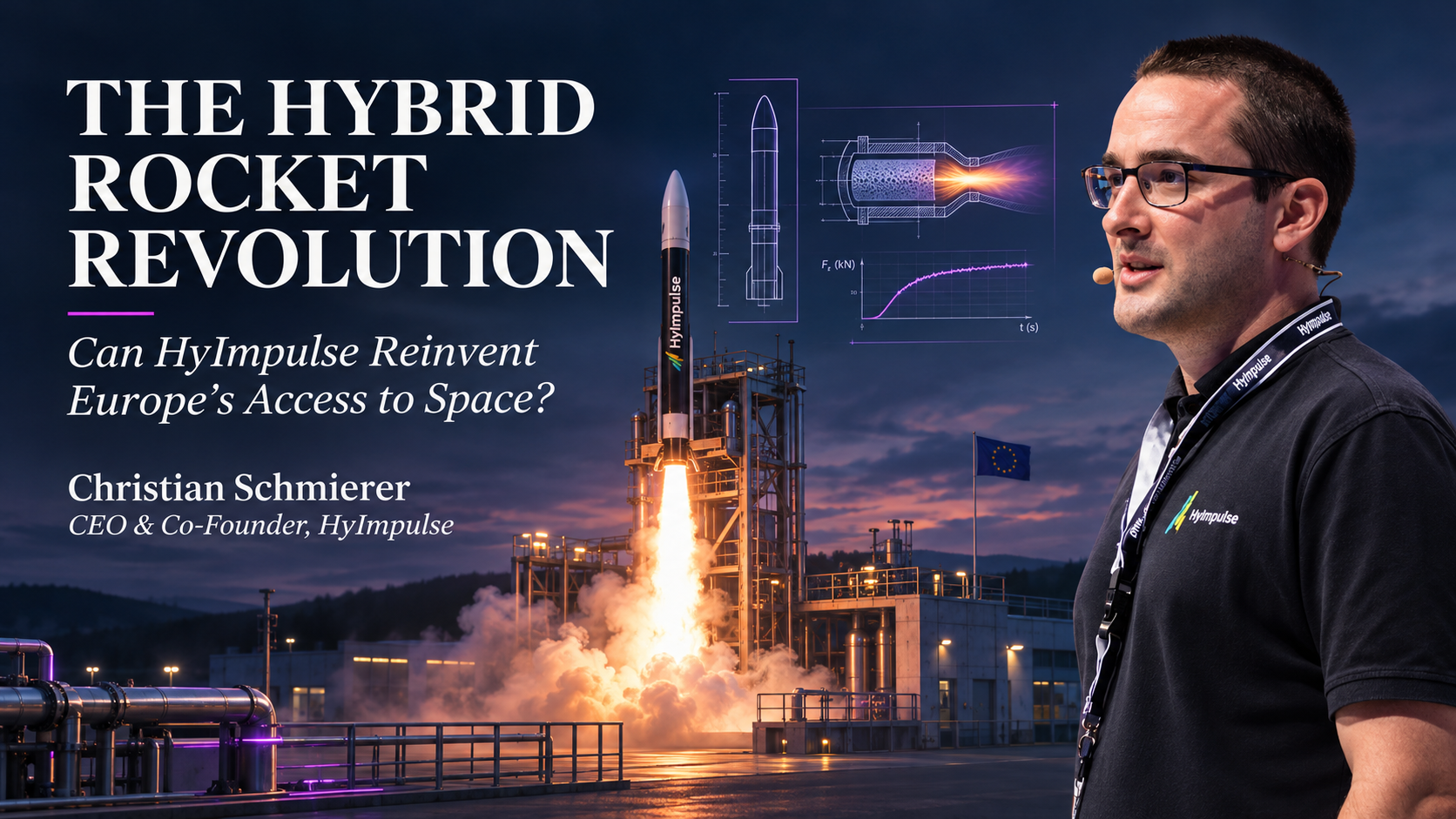
Most rockets burn two liquid propellants, which need pumps, pipes and cooling. HyImpulse burns a solid block of paraffin, the wax candles are made of, with liquid oxygen. Dr Christian Schmierer, co-founder and CEO of the German launch company, believes that one choice can halve the cost of a small rocket and help Europe launch its own satellites.
I'm Arn Terry, host of The Space Curious Podcast and founder of Daniel Ernest / DE Orbit, the space recruitment specialists. When Christian joined me on the show, he explained how a hybrid rocket works, why the industry has been asking the wrong question about launch prices, and what HyImpulse looks for as it doubles in size. Here's what I took from the conversation. His quotes are lightly edited for readability.
Where did HyImpulse come from?
Christian grew up near DLR Lampoldshausen, the German Aerospace Center's rocket engine test site in southern Germany. Family and friends talked about the rockets there, "but mysteriously I never saw a rocket flying." At about 16 he got an internship on the site to find out what was going on.
He went on to study aerospace engineering at the University of Stuttgart. In 2012 he joined HyEnD (Hybrid Engine Development), the student group where he met his co-founders. The students had chosen hybrid engines back in 2006 for three reasons:
With a DLR grant, the team set out to break the altitude record for student rockets using a liquid oxidiser. The first rocket failed. The second lost its data link. The third, launched from Esrange in Sweden, reached 32 kilometres. (They later found the second one too: it had flown almost 30.) That's when they realised how much this technology could do on very little money.
When they founded HyImpulse in 2018, they had three options: join one of Europe's government-led launcher programmes, move to the US, or build it themselves in Europe. They chose the third. The "Hy" stands for hybrid, and also for high specific impulse, a measure of how efficiently an engine uses its propellant.
How does a hybrid rocket engine work?
Inside the engine is a block of paraffin with a hole through the middle. Liquid oxygen is injected at the front, and the fuel burns from the inside out.
Some of rocketry's pioneers in the 1920s and 30s flew hybrids, but their fuels were weak, and the industry's money went into liquid and solid engines instead. Then in the 1990s, researchers at Stanford found that paraffin melts and behaves like a liquid as it burns, giving roughly the same energy as kerosene.
The hard part took 20 years of research to solve. There are no cooling channels, so the walls that hot gas touches directly need insulating. And if the oxidiser isn't injected properly, combustion becomes unstable.
The payoff is simplicity. Only one propellant has to be pumped, so there are fewer pumps, pipes, valves and tanks. Christian says that architecture alone can cut the cost of a rocket by 50%.
He's honest about the limit. HyImpulse's paraffin grains are already four metres long for a small launcher. An Ariane-sized rocket would need 20 to 30 metres of fuel, which would be impossible to handle. "It's really a technology that fits best into the small and medium launcher market."
Why is building a rocket still so hard?
Speed, not distance. Low Earth orbit is only 400 to 500 kilometres up, but you have to reach about 28,000 km/h to stay there. HyImpulse's "small" SL1 rocket will weigh around 50 tonnes, and only 1 to 2% of that is payload. "If the engineers make a mistake of 1% in their calculations, that means the payload is gone."
A traditional rocket has around 100,000 parts. Christian expects SL1 to have about 40,000. But HyImpulse had no playbook to follow. "We could not hire someone who did it already, or open a book where it would be described." The first four or five years were basic research just to reach a suborbital flight.
What did the first flight prove?
SR75 lifted off from the Koonibba Test Range in South Australia on 3 May 2024. Christian describes a first launch as binary: you spend five or six years getting there, and then it either works or it doesn't. "Even if we are all engineers, sometimes there are some emotions."
The flight proved the engine: stable combustion, with the thrust and specific impulse they'd predicted. It also revealed effects in flight that no ground test had shown. He can't disclose them, but they led to a redesign of parts of the motor.
The second SR75 flight, from SaxaVord Spaceport in Shetland, was planned for this autumn. A late licence pushed it to spring, when the winter winds die down. The light suborbital rocket is far more sensitive to wind than an orbital one.
Since then, the surprises have come from a different direction. One engine test this year "was so boring that we didn't learn anything new. That actually is also surprising when that happens."
What's next for SL1?
SL1 is a three-stage rocket: eight engines on the first stage, two on the second and a smaller upper stage. The new challenges are separating the stages, igniting engines in flight and adding a turbopump. SR75 was simply pushed by pressurised helium.
Because only the liquid oxygen needs pumping, HyImpulse doesn't need a fuel pump, which removes one of the most expensive parts of any rocket. In September the team spun the turbopump at full speed for the first time. Next comes pairing the pump with the motor, a full test of the second stage and the second suborbital flight.
Christian also stressed the part nobody sees from outside: software and avionics. Many rockets have failed on their first flight because of software, sensors or avionics.
Is price per kilogram the wrong question?
When HyImpulse first went to trade fairs, everyone asked how it would beat SpaceX on price per kilogram. "In our opinion, already back then, that was the wrong metric."
Customers on a rideshare have no say over their orbit or schedule. A dedicated launch lets them choose both, and eventually the launch site too. Dropping a satellite into its exact orbit means it uses less of its own propellant getting there, so it lives longer. That helps make up for a higher launch price.
Right now the question is even simpler: can you launch at all? Europe needs to launch hundreds of small satellites, while SpaceX is offering less capacity to other customers. "At the moment it's less about price. It's more about availability. And that will probably be the case for the next 10 years."
HyImpulse is also building MyMOVE, an orbital transfer vehicle. It can arrange satellites in formation, carry them the last mile after a large rocket drops them off, or act as a ready-made satellite for customers' payloads. Christian thinks many customers won't want to build satellites at all: "They just want to receive their data."
Who survives Europe's launch race?
In September HyImpulse added more than €50 million to its Series A, taking its total funding past €125 million. Christian says that pays for the run to a first orbital launch within about 18 months, possibly more than one. "Now we don't need to save money anymore."
He thinks demand over the next decade is high enough that any company that reaches orbit has a good chance. After that, expect consolidation; the collapse of Orbex in February showed not everyone will make it. I suggested Audi as a model, since its four rings stand for four car makers that merged. Christian expects a mix: several survivors, some mergers, and launch companies that become satellite operators too, as SpaceX already has.
Even if some companies fall away, he says Europe still comes out ahead, with a new generation of engineers and an industry that's more commercial and less government-led.
What does HyImpulse look for when it hires?
HyImpulse grew from 60 to 120 people in a year and expects to reach about 200 in the next, across sites in southern Germany and Glasgow. Which roles does it need? "All of them."
For engineers, what stands out is hands-on experience before graduating. "It's just important at university to look beyond the theory." As the company starts earning revenue, it needs sales, marketing, key account management, customer experience and finance too. More and more applications come from people outside the space industry, which Christian sees as a good sign.
Above any qualification, he wants accountability. In a scale-up, "not everything is there already." People have to take the lead "and not wait for someone else in the corporation to do it."
At DE Orbit, the space division of Daniel Ernest, we hear the same from fast-growing space companies. Engineering roles get the attention, but the commercial, finance and customer roles matter just as much, and people from outside space can do them well once they see the door is open.
Myth: Europe has already lost the launch race
Christian doesn't accept it. "If you take SpaceX out of the equation, the US launch market is actually not that far away from us." Catching up will take years, and for now the job is not to fall further behind. But the biggest myth, he says, is the feeling "that it's too late and we should just give up and launch everything with SpaceX."
Quick-fire round
Are you hiring?
If you're building a space team and need engineers, operators or leaders who have done it before, I'd like to hear about it. Email me at arn.terry@danielernest.com or connect with me on LinkedIn.
About The Space Curious Podcast
The Space Curious Podcast is hosted by Arn Terry and powered by DE Orbit, the space recruitment division of Daniel Ernest. Each episode talks to the founders, engineers and leaders building the space economy. The full conversation with Dr Christian Schmierer premieres on YouTube on Friday.
Daniel Ernest / DE Orbit helps space companies build mission-critical teams, from launch vehicles and propulsion to satellites, ground systems and space data. To find out more, visit Daniel Ernest / DE Orbit.