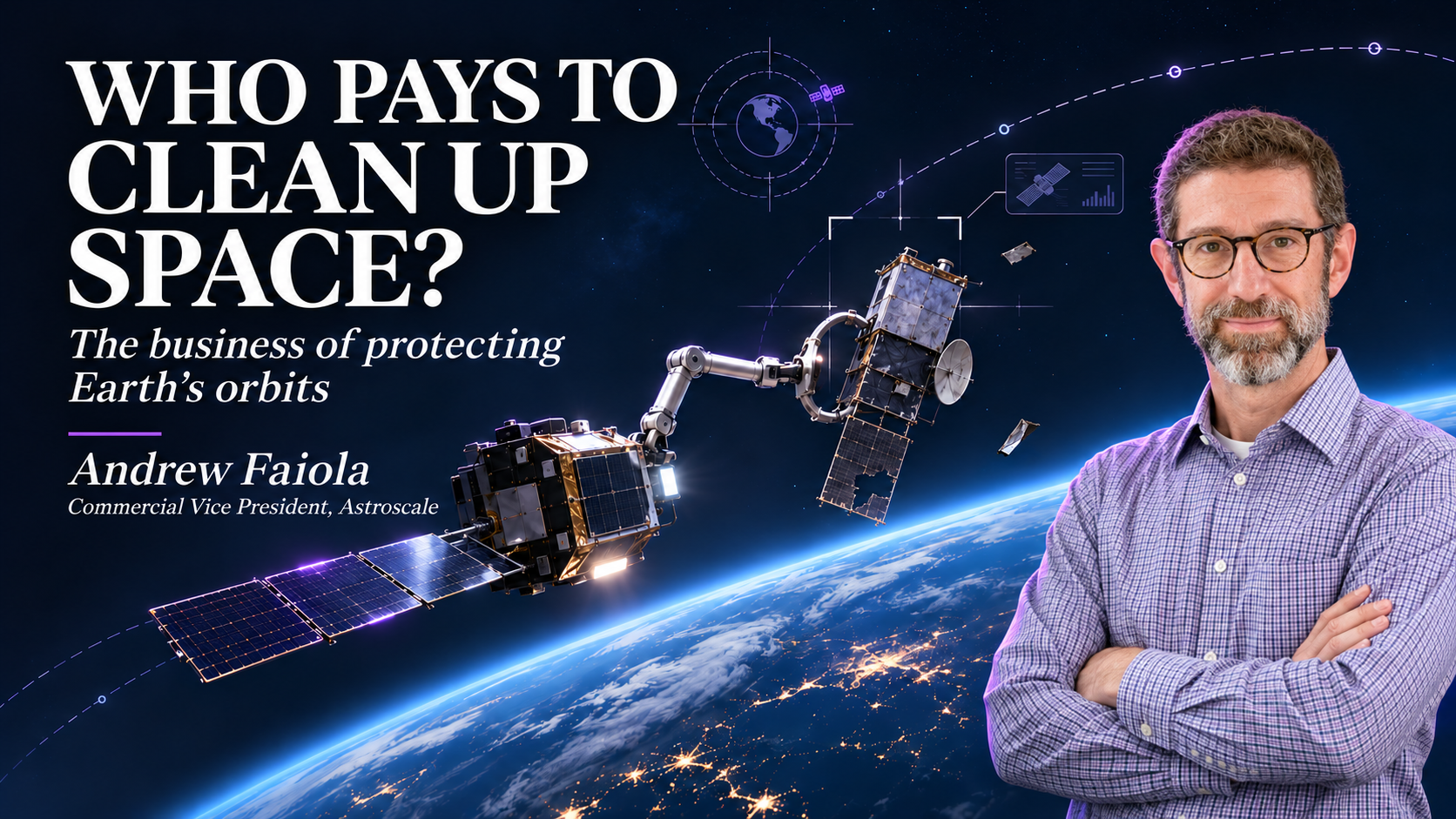
Modern life depends on satellites for communications, navigation, weather forecasts and financial transactions. If orbit becomes unsafe, the consequences won't stay in space. Andrew Faiola, commercial director at Astroscale UK, is helping to turn space sustainability from an important idea into a working commercial market.
I'm Arn Terry, host of The Space Curious Podcast and founder of Daniel Ernest / DE Orbit, the space recruitment specialists. When Andrew joined me on the show, we talked about why space needs cleaning, who pays for it, and why you don't need to be an engineer to build a career in space. Here's what I took from the conversation. His quotes are lightly edited for readability.
How did Andrew get into the space industry?
As a child, his hobbies were model rockets and amateur radio, which his dad got him into. Talking to people around the world over radio was "one of those expand-the-horizon moments".
He studied economics and international affairs, and during graduate school landed an internship in NASA's international relations department. It coincided with the first flight of the Space Shuttle Endeavour, STS-49, whose astronauts made the first three-person spacewalk to rescue a stranded Intelsat communications satellite. Years later, after a career in satellite communications including at Intelsat, he realised it had been one of the first big in-orbit servicing missions. "And then all of a sudden I'm at Astroscale."
The company's name reflects its mission: balancing the scales between economic growth in space and keeping orbit safe enough for everyone to keep using it.
What does a commercial director in space do?
Andrew runs business development, marketing and products: "the customer-facing part of the business". Every day is different, from meeting customers to dealing with an HR issue. The best part, he says, is understanding a customer's business well enough to spot problems they don't yet know they have.
The hardest part is selling protection against a risk hundreds or thousands of kilometres up, invisible to most people. He tells the story of his barber, also called Andy, who was amazed to hear that companies clean up space. On his next visit, Andy said he was suddenly seeing articles about space debris everywhere. Awareness grows once people see how much of daily life depends on space.
Do you need to be an engineer to work in space?
No. Andrew is not an engineer, though he knows "more than enough to be dangerous". Space is heavily engineering-led, and he urges anyone studying STEM subjects to keep going. But every space company also needs business development, HR, finance, marketing and legal people. "There are lots of jobs in space. You just have to be passionate about it and find your path."
The two skills that have helped him most are curiosity, about the job, people and what customers are trying to do, and collaboration. He quotes Paul Bate, former head of the UK Space Agency: "Space is a team sport."
Astroscale UK now employs about 230 people, and its HR team hired more than 100 in a single year. As a space prime that buys in parts rather than making everything itself, it also supports a large UK supply chain, from cable harnesses to solar arrays and batteries.
Why does space need cleaning?
Orbit is getting crowded. Companies are now talking about launching hundreds of thousands, even millions, of spacecraft over the next decade. Some models suggest we may already have entered Kessler syndrome, where debris creates more debris.
Andrew compares it to air traffic control. Better tracking lets aircraft fly closer together safely, and tracking in space is improving too. But it only goes so far. "As big as space is, it is finite." Alongside better tracking, the industry needs the ability to inspect, service and remove derelict objects, "just like you'd remove a broken-down car on the M25".
Why not just steer around the debris? Because every manoeuvre burns fuel, which shortens a satellite's life and the revenue it earns. Satellite operators are responsible for disposing of their satellites at the end of their life, either in a graveyard orbit or by bringing them down. The problem is the satellites that fail unexpectedly, some of which could take centuries to fall through other operators' orbits. Launches are already being held to let tracked objects pass.
What do inspect, service and remove mean?
They're Astroscale's three product lines, and all depend on one capability: rendezvous and proximity operations, or RPO. That means safely and repeatedly manoeuvring a spacecraft into very close range of another object, up to docking with it.
The European Union and the European Space Agency are already moving towards "zero debris" rules, encouraging satellites to be designed for removal, for example with docking plates.
What is ELSA-M?
ELSA-M is Astroscale's next big demonstration, due to launch around the end of 2027 on an Isar Aerospace rocket. It is designed to capture a Eutelsat OneWeb satellite, fitted with a docking plate, and bring it out of orbit. It's also designed to remove more than one satellite before the end of its own life.
Astroscale has already shown it can work in close proximity and dock in orbit. What's new is doing it with another company's commercial satellite. Andrew believes that will show regulators the technology is mature enough to build into the rules.
Why does regulation matter so much?
There are countless best-practice guidelines for responsible behaviour in space, "but there's very little penalty for non-compliance". Andrew compares it to nuclear power and North Sea oil rigs: nobody can build either today without planning and paying for decommissioning. Space has never worked that way, partly because the technology didn't exist. Now it's nearly mature.
"We're not suggesting you have to buy removal services from Astroscale or anyone else. We're saying you should operate this way, and there are lots of options. Go figure it out."
Space, he points out, has no borders. "It's a global commons. We've got an opportunity as humanity to treat space a bit differently, to get in front of a problem we've seen so many times before."
So who pays to clean up space?
Today, mostly governments: civil space agencies and organisations such as the European Space Agency, as with most new technology. SpaceX and Isar Aerospace both relied heavily on government funding before going fully commercial. Defence organisations are also showing strong demand. Andrew expects commercial operators to follow in a few years.
What is a circular space economy?
Today, space is a "single use, throwaway economy". Andrew compares it to owning a car: you don't abandon it when the fuel runs out, and you expect oil changes, new tyres and servicing along the way. Satellites get none of that.
Launch is still one of the most expensive parts of any mission, so he argues we should get the most from what's already up there: extending missions, finding second uses, refurbishing and recycling. One day, perhaps, old satellites could even become building material for Moon bases. "You've already done the hard part of getting something into orbit."
At DE Orbit, the space division of Daniel Ernest, we see in-orbit servicing companies like Astroscale hiring at real pace, for engineers and for the commercial, finance and HR people Andrew describes. It's one of the clearest examples of space creating new jobs at a time when many other sectors are cutting them.
Myth: there's plenty of room in space
The myth Andrew most wants to bust is "It's space, man, there's so much room up there." Better tracking helps, but only up to a point: the more crowded orbit gets, the more collision-avoidance manoeuvres satellites have to make, and the shorter their lives. "Think about it like the oceans or the rainforests. We have a lot of them, but they are finite resources."
What would routine in-orbit servicing look like?
Astroscale has an ambition to make in-orbit servicing routine by 2030. Andrew's definition: "It should be no different than being able to call the AA if you have a breakdown." Sending astronauts to the space station has become almost routine, and he expects servicing to follow as the number of satellites grows.
Quick-fire round
Asked what our generation must decide now, so a child born in 50 years inherits a safe orbit, Andrew's answer was simple. "We need to treat this seriously. It's not a science project. It's something we actually have to start grappling with today, and not kick the can down the road."
Are you hiring?
If you're building a space team and need engineers, operators or leaders who have done it before, I'd like to hear about it. Email me at arn.terry@danielernest.com or connect with me on LinkedIn.
About The Space Curious Podcast
The Space Curious Podcast is hosted by Arn Terry and powered by DE Orbit, the space recruitment division of Daniel Ernest. Each episode talks to the founders, engineers and leaders building the space economy. Watch the full conversation with Andrew Faiola on The Space Curious Podcast.
Daniel Ernest / DE Orbit helps space companies build mission-critical teams, from spacecraft and satellites to in-orbit servicing, mission operations and commercial leadership. To find out more, visit Daniel Ernest / DE Orbit.