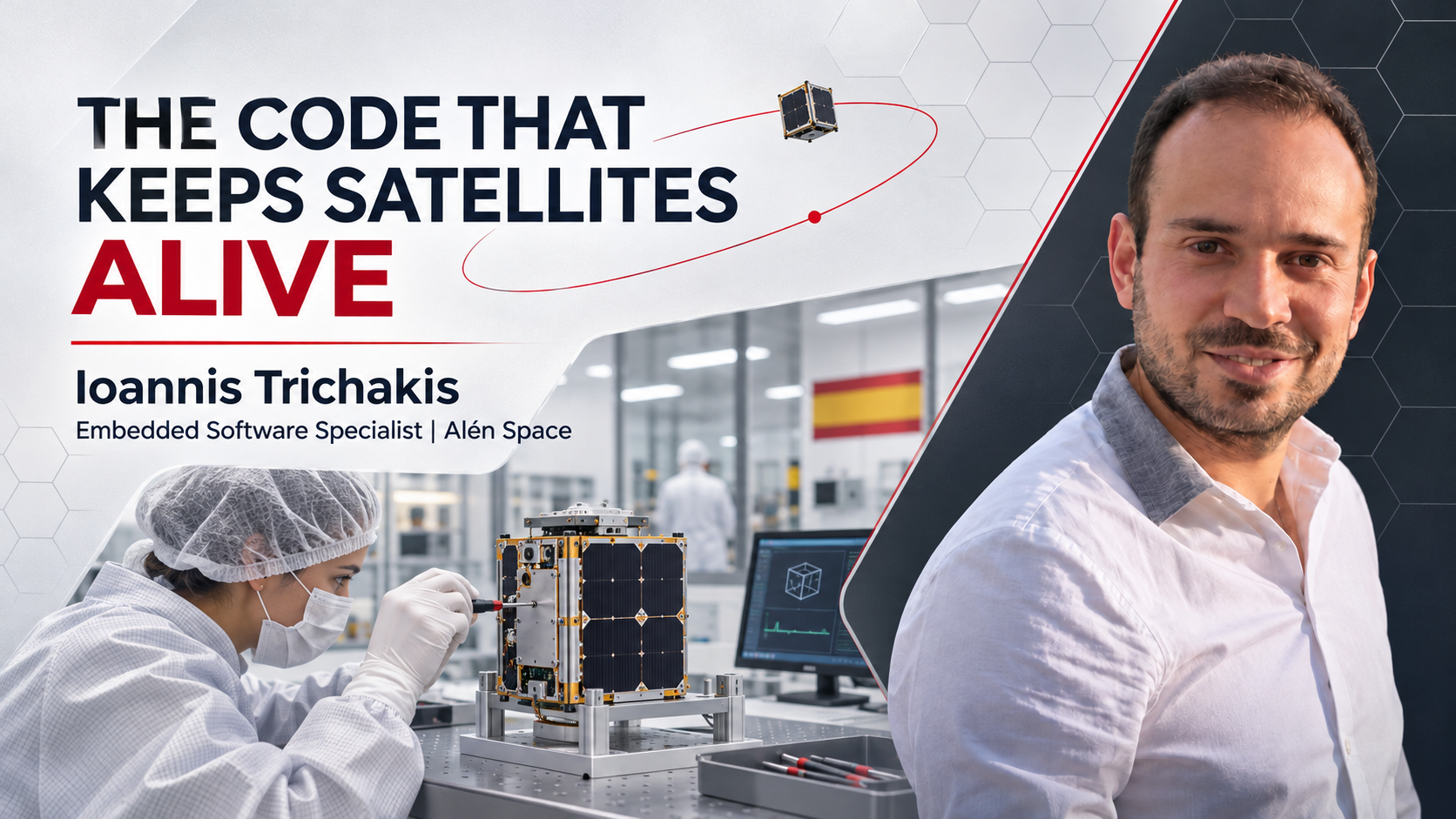
Twenty years ago, most of a satellite's behaviour was set by its hardware. Today it's mostly software, and that changes how satellites are built, fixed and upgraded in orbit. Ioannis Trichakis, principal software engineer at small-satellite maker Alén Space, part of the GMV group, writes the code that keeps them alive.
I'm Arn Terry, host of The Space Curious Podcast and founder of Daniel Ernest / DE Orbit, the space recruitment specialists. When Ioannis joined me on the show, he explained what satellite software does, why it has to be designed to fail safely, and how he moved into space from Boeing. Here's what I took from the conversation. His quotes are lightly edited for readability.
What does satellite software actually do?
Ioannis explains a satellite as a human body in orbit. The star tracker is its eyes, the radio that talks to the ground is its mouth, and the power system is its heart. The onboard computer is the brain, and that's where most of the software runs.
That software controls everything: communication with the payload and the ground, attitude control, fault detection, data storage and health reports for the operators. Ioannis describes it in layers:
The balance has flipped during his career. When he started in embedded systems in 2004, he reckons 60 to 70% of a system's behaviour was set by hardware. Today it's the reverse.
Why is writing code for space so different?
You can't reach the machine. A satellite in low Earth orbit travels at around 8 kilometres per second. Ioannis says a typical mission gets about three passes over a ground station by day and three by night, each lasting around 10 minutes.
The hardware is limited too: less power, memory and processing than any device on Earth. So most of the work happens before anyone writes a line of code. "For a project that lasts a year, I would say at least 60% of the time is the design phase." He puts the coding itself at about 10%, with the rest spent testing.
That's also why he has stayed in space since 2011, after moving from Boeing to SSTL in Guildford. Aviation software must follow the strict DO-178C standard. In space, "I felt like an artist that is free again."
What happens when something goes wrong in orbit?
Satellites run a strategy called FDIR: fault detection, isolation and recovery. Every few milliseconds, the software checks temperatures, currents and voltages against limits set during design. If something drifts, the onboard computer isolates the fault before it spreads.
For satellites in low Earth orbit, recovery is usually left to human operators to avoid unnecessary risk. Deep-space missions need more automation, because a signal from Earth may arrive too late.
That's why Ioannis says the best satellite software isn't the most brilliant. It's the software that fails safely. "There is no way in space missions that we will not encounter mistakes." When is code ready to fly? "The answer is never." A team is ready when it can prove that even if something goes wrong, the mission won't be lost.
Before launch, software goes through unit testing, then integration testing, then system testing on a model of the full satellite. The last step is "test like you fly": running real mission scenarios on the ground with the same tools operators will use.
Can you change a satellite after launch?
Ten years ago, barely at all: you could fix bugs, but a camera satellite stayed a camera satellite. Software-defined radios have changed that. Operators can now change a radio's frequency, modulation and coding from the ground, upgrade performance in orbit, and run different software for different missions.
Ioannis says some companies are working towards payloads that behave like a smartphone, where new capabilities are downloaded like apps. He credits software-defined radios with reviving satellite production growth after it stalled around 2010.
More software means more attack surface. Every recent Alén Space mission he mentions carries encryption or authentication. On a satellite, security has to be treated "as another subsystem" that takes power and processing like any other.
Where should AI take over, and where shouldn't it?
Ioannis sees three places where AI can help satellites soon:
He draws the line at safety-critical actions. Changing a satellite's operating mode or firing thrusters to dodge a collision should still have a human watching. "If something goes wrong there and no one can supervise it live, you could lose the satellite."
His keyword for the next decade is autonomy. Take a wildfire: today a satellite photographs it and waits for the ground to respond on a later pass. A smarter satellite could spot the fire itself and act straight away.
Can you move into space software from another industry?
Yes. "The doors are open for everyone." Ioannis studied telecoms in Edinburgh, then worked in automotive, aviation and even agricultural irrigation before space. One of his mentees came from Linux and C++ work with no satellite experience. Within a few years he was leading the Algerian Space Agency's software programme.
His advice is to learn systems engineering: what the subsystems are, how they talk to each other, and how faults are handled. The most underrated skill, he says, is communication. "With AI, writing the code isn't as difficult as understanding what you need to program."
At DE Orbit, the space division of Daniel Ernest, this is what we see too. Software engineers from automotive, aviation and industrial control already have most of what a space team needs. What they lack is someone to show them the door is open.
Myth: space software uses cutting-edge technology
People assume space engineers work on the latest chips and newest languages. Ioannis says the opposite is true. Satellites fly proven processors that are known to survive radiation and solar flares. "We're actually very traditional, something we know works."
Quick-fire round
Are you hiring?
If you're building a space team and need engineers, operators or leaders who have done it before, I'd like to hear about it. Email me at arn.terry@danielernest.com or connect with me on LinkedIn.
About The Space Curious Podcast
The Space Curious Podcast is hosted by Arn Terry and powered by DE Orbit, the space recruitment division of Daniel Ernest. Each episode talks to the founders, engineers and leaders building the space economy. Watch the full conversation with Ioannis Trichakis on YouTube.
Daniel Ernest / DE Orbit helps space companies build mission-critical teams, from spacecraft and satellites to ground systems, flight software and space data. To find out more, visit danielernest.com/de-orbit.