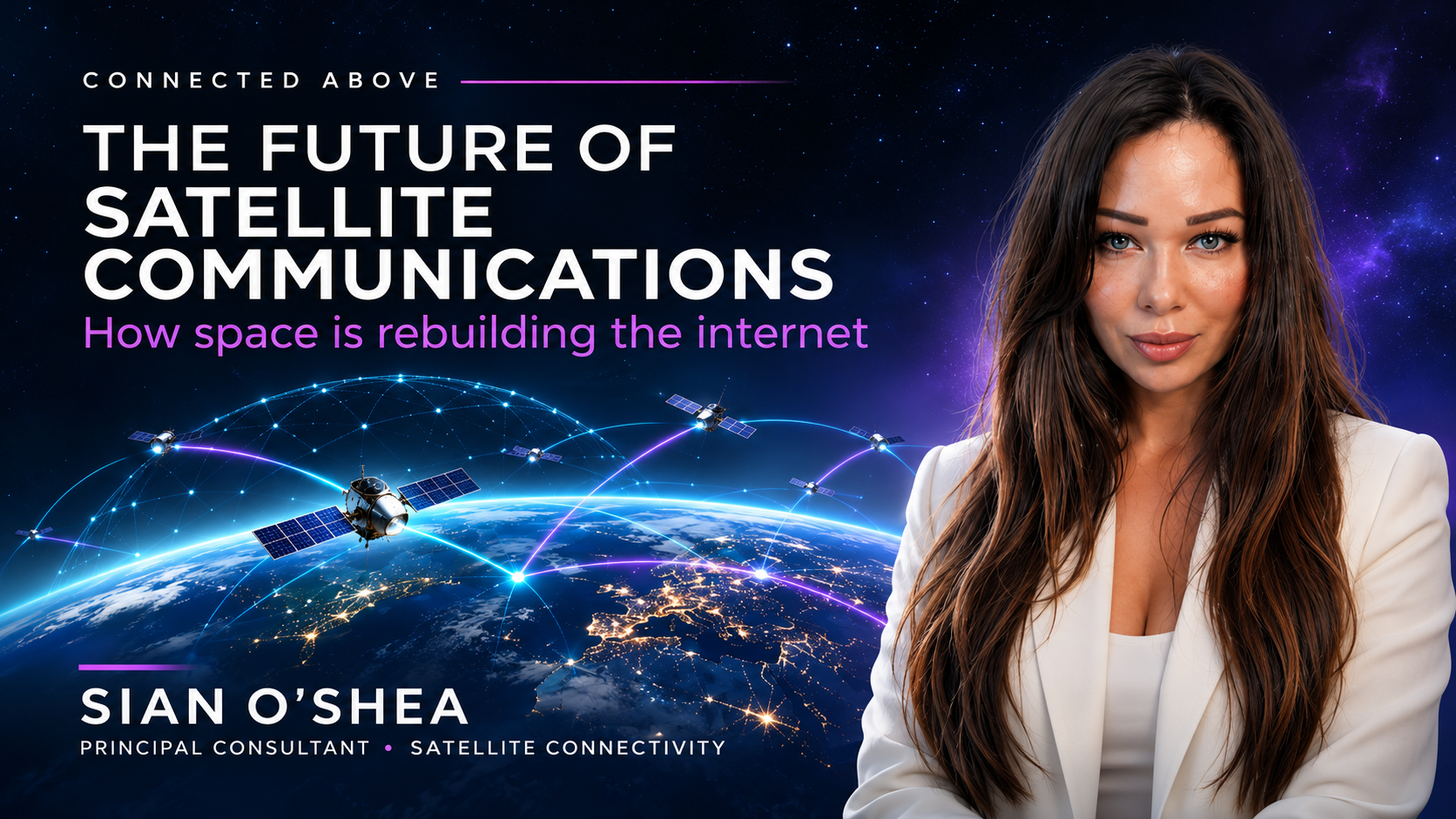
Satellite communication used to be a niche for militaries, ships and remote oil rigs. Now it's heading into every phone, car and mobile network. Sian O'Shea, a telecoms business consultant with 17 years in the industry, expects a huge rise in satellite communications over the next five to ten years.
I'm Arn Terry, host of The Space Curious Podcast and founder of Daniel Ernest / DE Orbit, the space recruitment specialists. Sian was my guest on episode two, after 59% of my LinkedIn audience voted for satellite communications as the topic. Here's what I took from the conversation. Her quotes are lightly edited for readability.
What is satellite communication?
Sian likes to explain things as if to a five-year-old. Her analogy is the old Heineken advert: satellites reach the parts other networks cannot reach. Traditional telecoms are limited by signal, distance and coverage, which is why rural areas have long had slow broadband.
With satellite communication, a ground station sends a signal up to a satellite, which amplifies it and sends it back down. Depending on the provider, coverage is close to 100% of the planet. You could be a fisherman far out at sea, a passenger on a plane, or a soldier needing secure communications.
How does satellite communication help everyday life?
Sian calls it "such a force for good". Charities and NGOs rely on it to coordinate disaster relief where normal networks are down. Shipping companies use it to monitor and reroute vessels, cutting fuel use and emissions. It's used to track whales and to catch illegal fishing.
The next big change is direct-to-device: satellite connectivity straight to an ordinary mobile phone. No special satellite phone is needed to send an emergency text or call for help from a mountain or a forest. "Imagine the reassurance of knowing that even if you haven't got standard mobile coverage, you can rely on satellite."
Cars are going the same way. Buyers increasingly expect always-on connectivity for remote diagnostics, navigation and service alerts, and more of that is delivered by satellite.
How has Starlink changed satellite communications?
First, it made people aware of the industry. "A few years ago, if you mentioned satellite communications, you'd have got a lot of blank faces." Sian credits Elon Musk with making it, in her words, "a bit sexy".
Second, it changed the business model. Satellites in low Earth orbit (LEO) are closer to Earth, quicker to launch and give fast speeds. That let Starlink make "a LEO land grab" and win the consumer market, not just governments and big companies. Sian points out that Starlink is the real money-maker behind SpaceX.
The older players traditionally relied on geostationary (GEO) satellites. These sit much higher, so one satellite covers far more of the Earth, but they can take years to build and launch. Starlink pushed them towards hybrid networks mixing LEO, GEO and mesh, which Sian says is better for customers.
Can anyone compete with Starlink?
Yes, if they pick the right part of the market. Sian's one to watch is Amazon Leo, formerly Project Kuiper. Where Starlink went after consumers, Amazon can target big businesses through AWS, with easy integration, scale and a trusted brand.
The established operators still have credibility and long contracts with governments and the military, who want "tried, tested, trusted brands". Data sovereignty matters more too: some governments and companies now want a European or US-based provider.
She also sees Africa as a large, mostly untapped market. Unlike traditional broadband, where nearly everyone is already connected, satellite in rural areas means genuinely new customers.
Will mobile networks and satellites merge?
Sian believes satellite will become a standard part of every mobile operator's service within a couple of years. "It's going to be the only way they can actually offer that always-on connectivity." It lets operators extend coverage without building whole new networks, as long as their own networks are made satellite-ready.
Partnerships between mobile operators, satellite companies and handset makers are already forming. The early movers, she says, will capture the customers. I'd add that the companies that refuse to adapt risk going the way of BlackBerry and Blockbuster.
What are the cybersecurity risks for satellites?
Like any network, satellites are exposed to cyberattack, and "warfare isn't traditional warfare as much now, it's cyber warfare." Satellites bring their own problem: many are expected to last 10 to 20 years. Over that time encryption standards change and new threats appear.
Sian's answer is remote software updates, zero-trust architecture across ground stations and network management, and constant vigilance. "Technology introduces the vulnerabilities, but technology is also the answer."
What is the environmental cost of satellites?
Satellite communications help monitor climate change and cut emissions, but they have a footprint too. Launches burn large amounts of fuel, and more satellites mean more risk of collisions and debris. Satellites at the end of their life have to be retired without leaving debris behind.
Sian says much more work is needed, and points to the European Space Agency's research into reducing the environmental impact. Supply chains matter as well: many satellite components are niche, hard to source and on long waiting lists, and buyers can push suppliers for greener credentials.
Do you need to be technical to work in satellite communications?
No, and this was the message Sian most wanted to land. The industry needs software engineers, network engineers and antenna designers, "but it's much wider than that":
She'd also like to see the industry become more diverse. It can still look male-dominated, but that is changing.
At DE Orbit, the space division of Daniel Ernest, we see this across satellite operators. Programme managers, commercial leaders and analysts who understand both telecoms and space are some of the hardest people to find, and some of the most valuable.
Quick-fire round
Are you hiring?
If you're building a space team and need engineers, operators or leaders who have done it before, I'd like to hear about it. Email me at arn.terry@danielernest.com or connect with me on LinkedIn.
About The Space Curious Podcast
The Space Curious Podcast is hosted by Arn Terry and powered by DE Orbit, the space recruitment division of Daniel Ernest. Each episode talks to the founders, engineers and leaders building the space economy. Watch the full conversation with Sian O'Shea on The Space Curious Podcast.
Daniel Ernest / DE Orbit helps space companies build mission-critical teams, from satellites and ground systems to satellite communications, networks and space data. To find out more, visit danielernest.com/de-orbit.