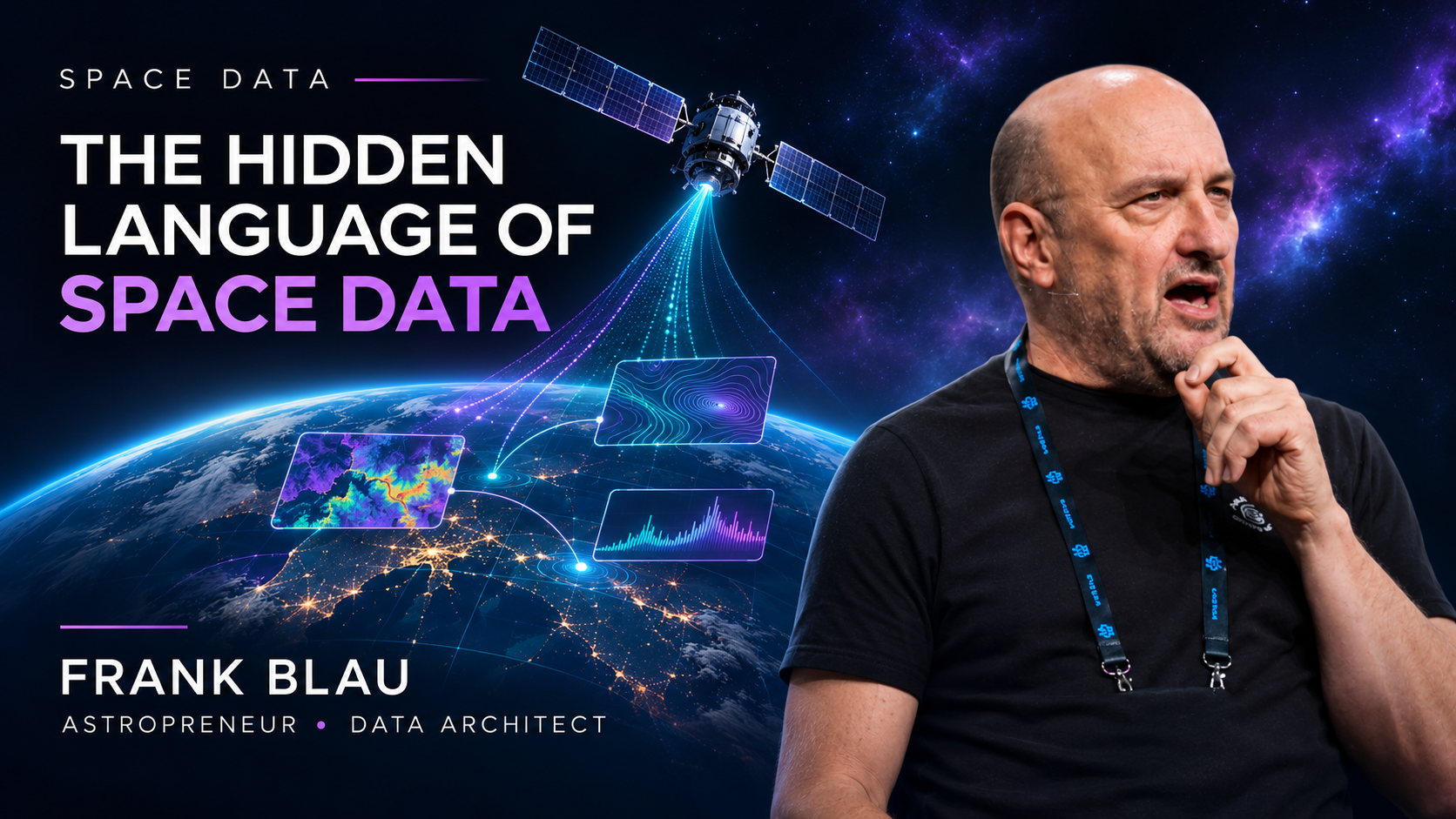
Every satellite produces data, but data on its own tells you nothing. Frank Blau, a data architect based in western Austria, has spent four decades turning information into insight. He studied literature and poetry, never took a computer science class, and now builds data models for space projects.
I'm Arn Terry, host of The Space Curious Podcast and founder of Daniel Ernest / DE Orbit, the space recruitment specialists. When Frank joined me on the show, we talked about how space data works, why debris is a problem of will, and how people outside the industry can find their way in. Here's what I took from the conversation. His quotes are lightly edited for readability.
How does a poet become a data architect?
Frank's route into data was an accident. Working as a technical writer for a company that built radio amplifiers, he was handed an early computer to try. On one of its floppy disks was a database program. "To be honest, it changed my life."
He fell in love with designing databases rather than just using them, and found he could picture the tables and links in his head before writing any code. His career has since covered healthcare, gaming and manufacturing. In the late 1980s, his first space project involved machining the huge rocket cylinders redesigned after the Challenger disaster.
Why does every dataset need a story?
Frank's TED talk applies Marshall McLuhan's idea that "the medium is the message" to data. Most people think you need the content before you can design the structure. Frank argues it's the other way round: start with the story you want to tell, and the right structure follows.
Different databases tell different stories:
That's why his first question to any client is: "What's the story you're trying to tell?"
Why is data so important in space?
Frank breaks space data into layers:
In-orbit processing excites him most. He has been approved as an experimenter on an Austrian satellite and plans to run calculations on its images in space, sending only the results down. In the past, all the raw data would have come to Earth to be processed.
Security raises hard questions. Frank is working on a project to photograph satellites already in orbit, so insurers can check whether they're working. "The minute you can take a picture of another satellite, what else could you do?" He believes these issues need coordinated, top-down thinking, not individual companies working alone.
How serious is space debris?
Objects larger than about 10 centimetres are tracked, but most debris is smaller, and Frank says a fragment as small as half a centimetre can disable a satellite. The worst case is Kessler syndrome, the cascade shown in the film Gravity, where collisions create debris that causes more collisions until orbits become unusable.
Frank wrote a game where you launch and retire satellites while avoiding collisions. "In almost every single way you play the game, you lose," because debris creates more debris.
He compares it to climate change. "It's not just a problem of technology. It's also a problem of will." Everyone knows it's happening, roughly why, and what happens if nobody acts. Yet there's little coordinated effort to solve it at a planetary level, and he expects it to get worse.
How can companies outside space get into the industry?
Frank lives in Vorarlberg, in far western Austria, surrounded by high-tech manufacturers. Airbus is 25 minutes away in Friedrichshafen, and Munich has Isar Aerospace. Yet most local firms have never thought of themselves as space suppliers. He is working with the European Space Agency and local companies to change that.
His pitch is concrete. He shows a textile company photos of the inside of the International Space Station, where specialist fabric covers almost every surface. He shows a hinge maker a CubeSat deployer with 400 hinges. "What if you, a local high-tech company, could bid on that?"
His advice for anyone looking for space opportunities is to "look behind the curtain". When he moved to Austria, he drove around with a notebook, writing down every company in every business park, including the ones not named on the front of the building. "There's a whole subsystem of people doing interesting things around you. They're just not bragging about it."
Read the culture, too. In Austria and Germany, cold calls are seen as rude. Meetups, entrepreneur groups and personal introductions work better.
What skills make you ready to work in space?
Frank mentors young founders through Austria's Youth Entrepreneurship Week, where his keynote was called "Your Analog Brain Is Your Competitive Advantage". Knowing a programming language isn't enough, he says. You need to be "gig ready", like a musician who can also do the sound check, haul the gear and tune between songs.
For technical roles, that means knowing Git, Docker and containers, APIs and SQL before you arrive. Skills from bands, kitchens and writing books transfer too. Planning a multi-course meal, he points out, is project management with a critical path.
On AI, Frank says you no longer need to master orbital mechanics to work on space data. But you do need to know which questions to ask. "Spend some time thinking about your stories, because that's what you're going to feed into this thing." And AI still can't build things: the skills that go into making hardware will stay in demand.
At DE Orbit, the space division of Daniel Ernest, we see the same opportunity. Many of the people space companies need already work in manufacturing, software and data in other industries. They just haven't been shown that space needs them.
Quick-fire round
Are you hiring?
If you're building a space team and need engineers, operators or leaders who have done it before, I'd like to hear about it. Email me at [arn.terry@danielernest.com](mailto:arn.terry@danielernest.com) or connect with me on [LinkedIn](https://www.linkedin.com/in/arnterry/).
About The Space Curious Podcast
The Space Curious Podcast is hosted by Arn Terry and powered by DE Orbit, the space recruitment division of Daniel Ernest. Each episode talks to the founders, engineers and leaders building the space economy. Watch the full conversation with Frank Blau on YouTube.
Daniel Ernest / DE Orbit helps space companies build mission-critical teams, from spacecraft and satellites to ground systems, space data and AI. To find out more, visit [danielernest.com/de-orbit](/de-orbit).