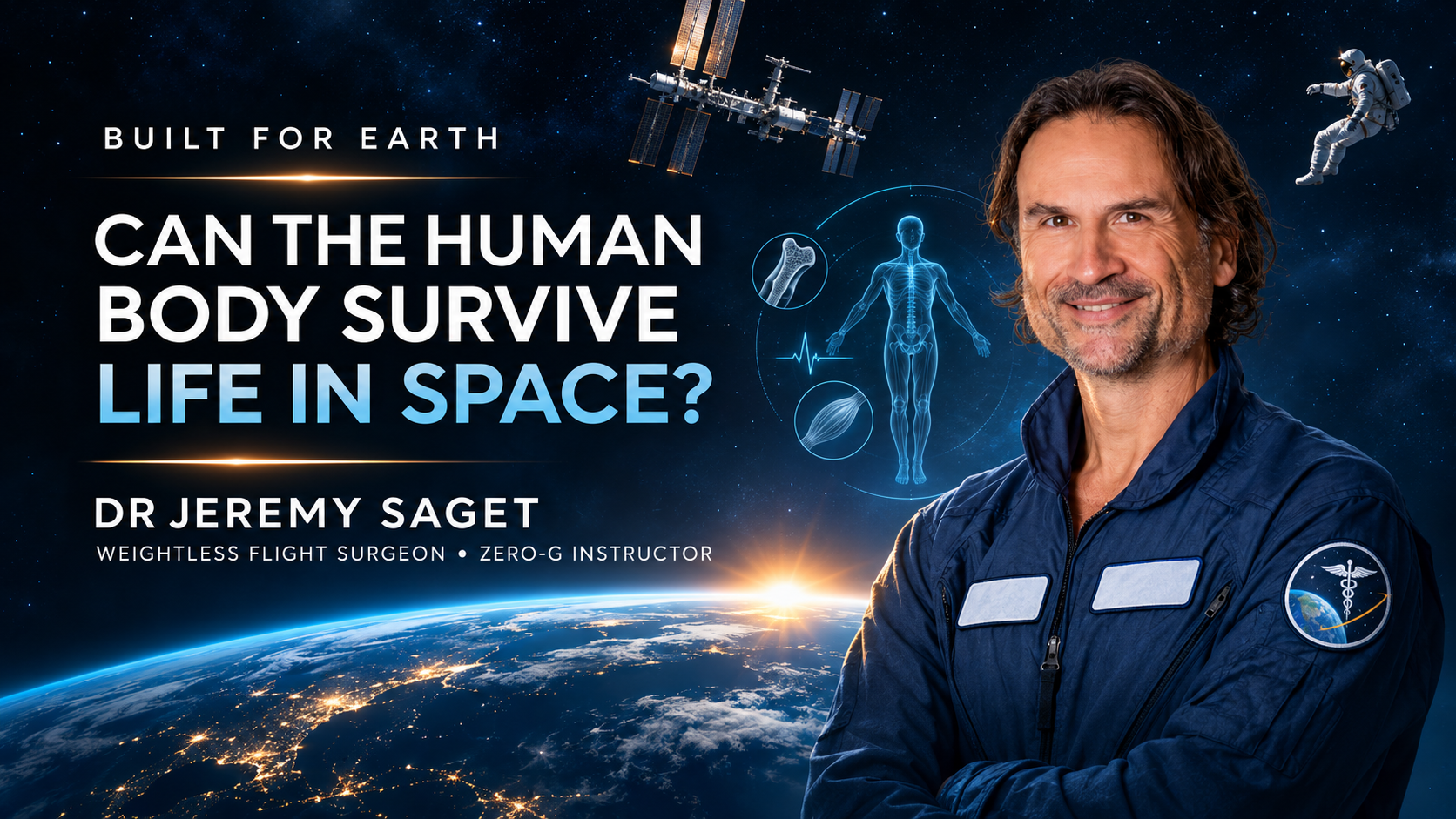
Humans were shaped by one gravity, on one planet. So what happens to the body and mind when you leave? Dr Jeremy Saget has spent more than two decades finding out. He is an aerospace physician, a weightless flight surgeon and zero-G instructor, chief medical officer at Titans Space Industries, and dean of Titans Space Academy, which trains commercial astronauts.
I'm Arn Terry, host of The Space Curious Podcast and founder of Daniel Ernest / DE Orbit, the space recruitment specialists. When Jeremy joined me on the show, he explained what weightlessness does to us, whether we're medically ready for Mars, and what makes a good astronaut. Here's what I took from the conversation. His quotes are lightly edited for readability.
What does an aerospace physician do?
"An aerospace physician is still a doctor, whose patient is interacting with an extraordinary environment." The work covers astronaut and family medical support, fitness-to-fly assessments, research and operational medicine. On parabolic flights, which create short periods of real weightlessness in an aircraft, Jeremy assesses participants, briefs crews, monitors the flight and debriefs afterwards.
It's a small club. France flies Europe's largest weightlessness laboratory, and has required a flight surgeon on board since 1989. Jeremy says only around seven people in the world do his job.
His path wasn't planned. His first post as a doctor was treating leprosy patients in the Indian Ocean. He has been a family doctor for over 20 years, ran geriatric and rehabilitation departments during the Covid pandemic, and served as a flight surgeon on aeromedical evacuation teams for peacekeepers in a conflict zone. "Life is the best training."
The exciting shift now, he says, is commercial spaceflight. Space medicine is moving "from the medicine of selection to the medicine of inclusion": from asking who is healthy enough to fly, to how more kinds of people can fly safely.
What happens to the body in weightlessness?
First, you lose your sense of up and down. Weightlessness isn't the absence of gravity: you're falling around the Earth along with the spacecraft, so you no longer feel your weight. The balance system in your inner ear was calibrated for Earth's gravity, so at first you're disorientated, but the brain adapts very quickly.
Then every system in the body starts to change:
Jeremy stresses that this is adaptation, not disease. But six months on the space station can age some systems by the equivalent of 10 to 20 years, mostly reversibly. That's why astronauts are a model for studying ageing on Earth.
On the ground, researchers mimic weightlessness with months of bed rest tilted six degrees head-down, or "dry immersion" in water. But only parabolic flights and spaceflight produce the real thing.
What is the biggest medical risk in space?
Radiation. On Earth, and largely in low Earth orbit, the planet's magnetic field protects us. Beyond it, astronauts face constant galactic cosmic rays plus bursts of radiation from the Sun. Over a career, the agreed exposure limits raise an astronaut's lifetime risk of dying from cancer by about three percentage points, from around 20% to 23%.
Shielding helps, but only partly. About 20 cm of water can protect against solar storms, but not against cosmic rays, which create secondary particles as they pass through. "It's not just a medical problem. It's a biological, engineering and mission design problem."
The bigger point is that no risk comes alone. Jeremy calls it the space "exposome": radiation, altered gravity, isolation, confinement, disrupted sleep, dust, noise, diet, microbes and limited medical care, all interacting. "You don't experience radiation on Monday, isolation on Tuesday and microgravity on Wednesday. You experience all of them at once."
Is living on the Moon different from living on Mars?
Both have partial gravity, and nobody yet knows the "gravity prescription": how much gravity the body needs to stay healthy. Jeremy's team now flies reduced-gravity parabolic flights to study it.
The Moon adds radiation and abrasive dust, but Earth is only three days away and messages arrive in seconds. Mars is fundamentally different: a mission of more than 900 days, communication delays of up to 22 minutes each way, no possibility of evacuation, and the "out of view" effect of not being able to see Earth at all.
Are we medically ready for Mars?
"We know enough to contemplate it seriously, but not enough to pretend that it will be medically routine." The Moon, he says, is the right place to prepare. The goal isn't zero risk, which is impossible, but to understand the uncertainty, reduce it intelligently and make sure everyone involved can give informed consent. "Exploration has always involved uncertainty."
What happens to the mind in space?
People are remarkably resilient, but isolation and confinement wear away at privacy. In a small crew, it's often not big conflicts that cause trouble but small irritations piling up. Sleep, boredom and separation from family aren't comfort issues; they affect decision-making and safety.
That's why selection has changed since the "space cowboy" days of Mercury and Gemini. "We are not looking for the best individuals. We are looking for the best crews." Jeremy looks for:
Ego, he says, is the worst reason to want to be an astronaut.
What skills will space healthcare need?
Jeremy wants crews of generalists, each with a specialist peak. Medical skills should belong to the whole crew, not one doctor, because "the doctor can also be the patient". AI decision support and robotics will help, but humans must always be able to overrule them.
He also wants creativity on board. For deep space, an artist with the right skills could be invaluable, because new problems need new ways of thinking.
For doctors who want to enter aerospace medicine, his advice is simple: first, become a good doctor. Then build real expertise in something useful, such as emergency medicine, research or human factors, and learn to work in multicultural teams. "Become useful first, then take that usefulness towards space." He points out that the first surgery ever performed in weightlessness took place on his aircraft in 2006.
At DE Orbit, the space division of Daniel Ernest, I find this one of the most hopeful messages for anyone thinking about a space career. The industry doesn't need people who look like the astronauts of the 1960s. It needs people who are excellent at something, and who work brilliantly in a team.
How is training commercial astronauts different?
Agency astronauts were a small, uniform group selected for specific missions. Commercial spaceflight means designing vehicles, stations and training for a far wider range of people. Jeremy sees it as fairer access to space, and points out that a disability on Earth can become an ability in weightlessness.
He compares it to aviation, which began with daring pioneers and military pilots and became something almost anyone can do. Space needs the same infrastructure: the equivalent of airports, routes and rails.
Myths about astronauts and weightlessness
Should we change our environment or our bodies?
Jeremy's instinct is to adapt the environment to humans wherever possible: radiation shielding, life support, nutrition and perhaps artificial gravity. Changing the human body raises much deeper ethical questions, especially if the changes could be inherited. "There is an important distinction between helping humans adapt to another world and redesigning humans for another world."
He's confident we'll see a growing, sustained human presence on the Moon. Permanent settlement is a much higher bar, needing reliable energy, food, healthcare, governance and an economy that lasts generations. "Settlement begins when staying is no longer a mission objective, but an ordinary condition of life."
Quick-fire round
My final question was about the first child born on Mars, whose body might never cope with Earth's gravity. Jeremy's answer: "Civilisation begins when another world begins shaping the humans who live there." That moment would be both an extraordinary achievement and an extraordinary responsibility, so the ethical debate has to happen before the technology arrives.
Are you hiring?
If you're building a space team and need engineers, operators or leaders who have done it before, I'd like to hear about it. Email me at [arn.terry@danielernest.com](mailto:arn.terry@danielernest.com) or connect with me on [LinkedIn](https://www.linkedin.com/in/arnterry/).
About The Space Curious Podcast
The Space Curious Podcast is hosted by Arn Terry and powered by DE Orbit, the space recruitment division of Daniel Ernest. Each episode talks to the founders, engineers and leaders building the space economy. Watch the full conversation with Dr Jeremy Saget on YouTube.
Daniel Ernest / DE Orbit helps space companies build mission-critical teams, from spacecraft and space stations to human spaceflight, mission operations and safety. To find out more, visit [danielernest.com/de-orbit](/de-orbit).
Sources
Jeremy Saget, gravity-free flight instructor, Air Zero G